Digital Marketing for Solar Companies: A Complete Guide
A plain guide to digital marketing for solar companies: the website, local SEO, Google and Meta ads, lead generation, follow-up and the numbers worth tracking.
The short answer: Digital marketing for solar companies works when five parts run together: a fast website that explains your offer, a strong local search presence, Google and Meta ads that bring in quality inquiries, instant follow-up on every lead, and tracking down to the signed contract. Skip any one and the others leak money.
In this guide:
By Bernard Picardal Jr, founder of Able To Do. He builds lead generation and follow-up systems for home service and solar companies in the US and Canada.
Solar is a high-ticket, long-consideration sale. A homeowner may read for weeks, get three quotes and ask a neighbor before booking anyone. Your marketing has to earn attention, earn trust and then answer fast. This guide covers each piece. It supports our solar marketing service page.
Digital marketing for solar companies: the full picture
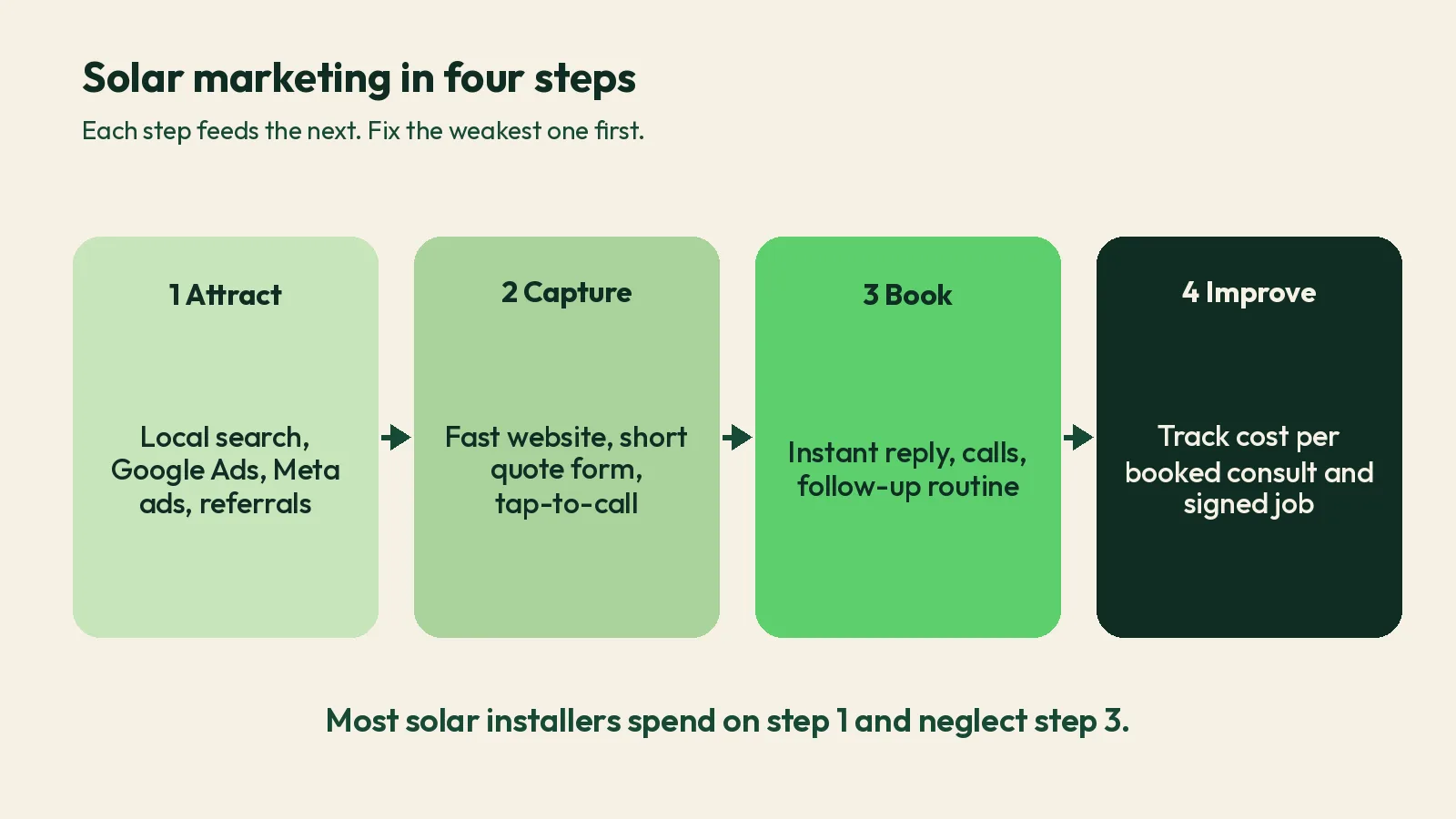
Think of it as four steps. We call it the Attract, Capture, Book, Improve growth system.
- Attract:** local search, Google Ads, Meta ads and referrals put you in front of homeowners.
- Capture:** a fast, clear website and short forms turn visits into inquiries.
- Book:** instant replies and a follow-up routine turn inquiries into consultations.
- Improve:** you track cost per booked consultation and cost per signed job, then fix the weakest step.
Most installers spend almost everything on Attract and almost nothing on Book. That's backward. If you're already getting leads and they don't turn into jobs, start with leads but not booking jobs before you raise your ad budget.
Your website: the base of solar marketing
Every channel sends people to your site. If it's slow or vague, you pay for the same click twice. A solar website needs to do a few things well.
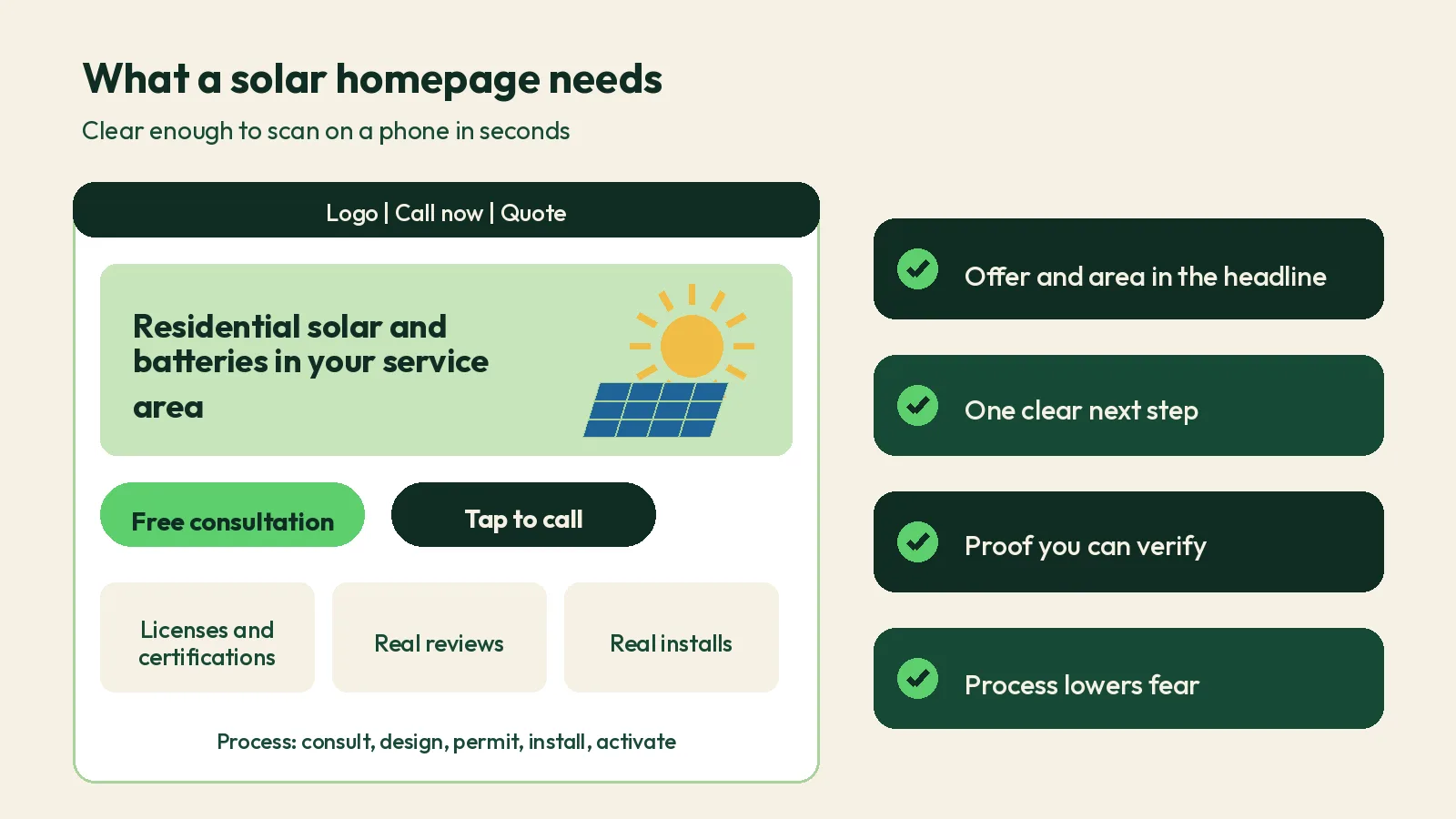
- Say what you do and where.** "Residential solar and battery installation in [your service area]" beats "Powering a brighter future."
- Show proof you can verify:** licenses, certifications you hold, manufacturer partnerships and real reviews. Use only what's true and current.
- Explain the process:** consultation, design, permitting, installation, inspection, activation. Homeowners fear the unknown more than the price.
- Offer a low-friction next step:** a short quote or consultation form and a tap-to-call button.
- Be honest about incentives and savings.** Rules and rates change by state and utility. Link to a current source such as the U.S. Department of Energy's solar pages and avoid promising specific savings you can't back up.
Speed matters. Google's Core Web Vitals guidance says the main content should load within 2.5 seconds. Most solar shoppers are on a phone. Our fast contractor website post covers the fixes, and our contractor websites page shows how we build them.
Local SEO for solar installers
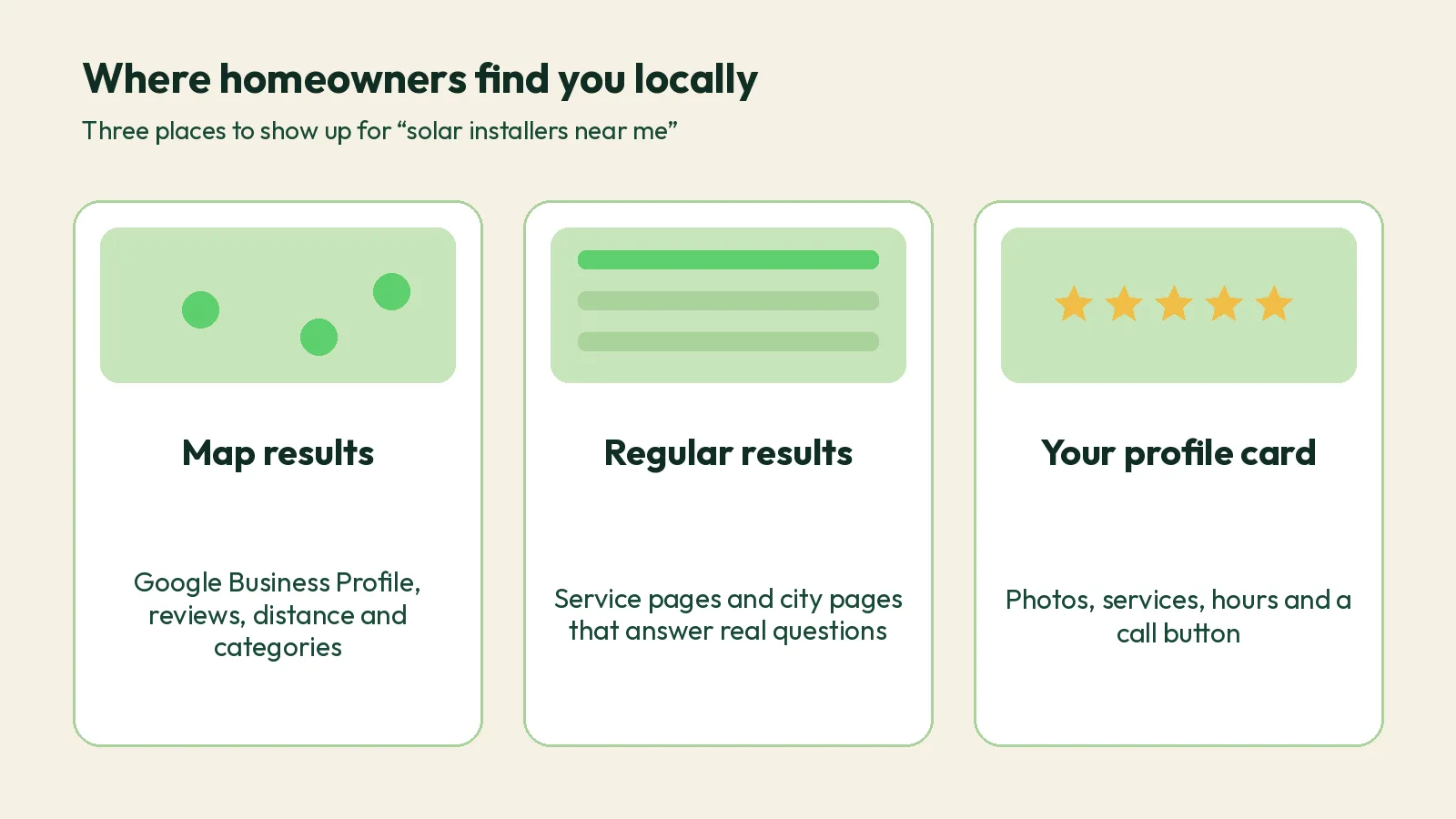
Many homeowners search "solar installers near me" or the name of their city. Local SEO is how you show up there without paying per click. It has three parts.
Google Business Profile
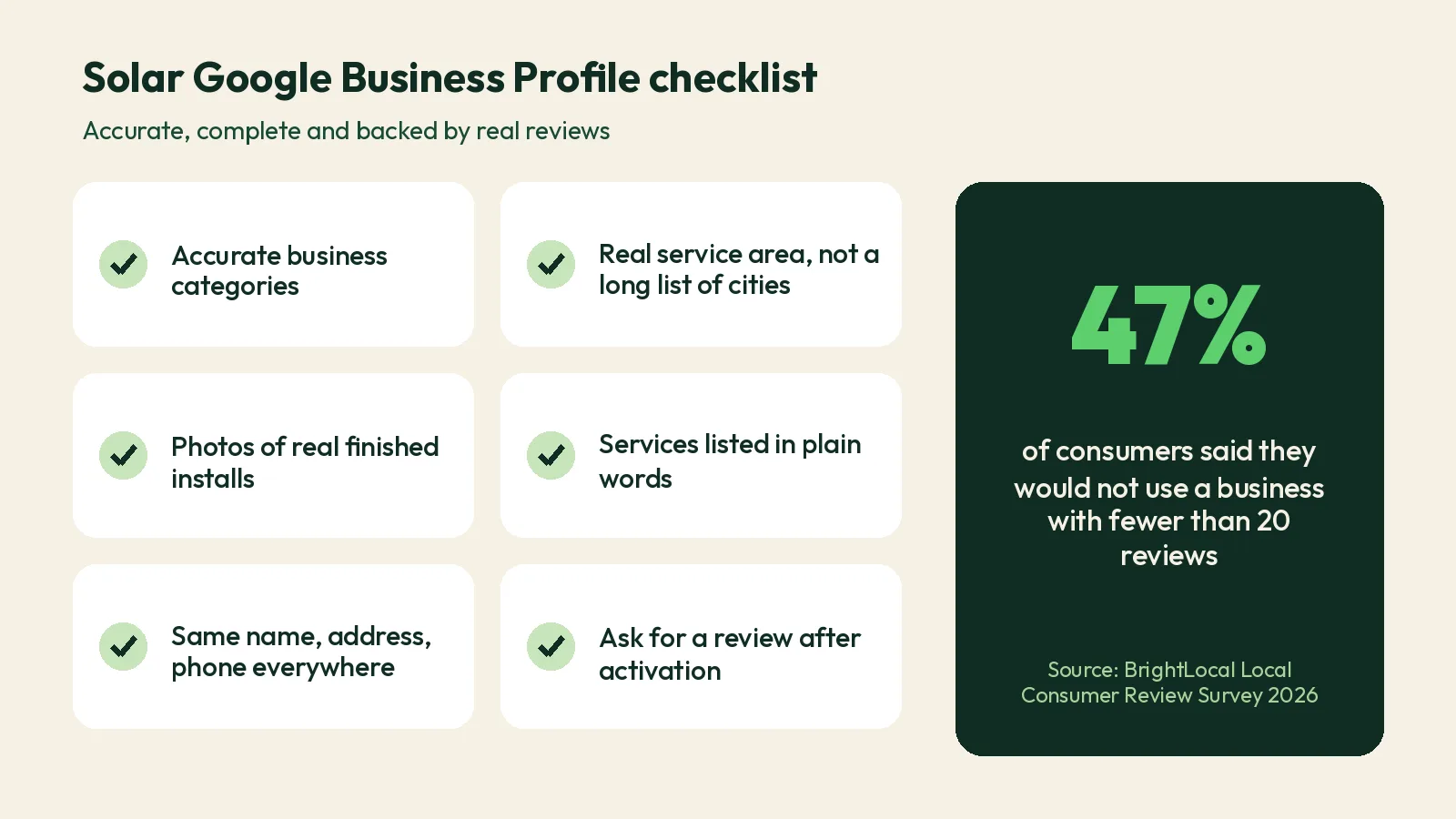
Your profile is often the first thing a homeowner sees. Pick accurate categories, list your real service area, add real photos of finished installs and keep your name, address and phone number consistent. Google's guidelines for representing your business explain what's allowed. Our Google Business Profile guide for plumbers applies almost line for line to solar.
Reviews
Reviews work as proof. In BrightLocal's 2026 survey, 47% of consumers said they wouldn't use a business with fewer than 20 reviews. Ask every happy customer, right after activation day, with a direct link. Never buy reviews or write your own.
Service pages and local content
Give each service its own page: residential solar, battery storage, commercial solar, EV charger installation. Add pages for areas you really serve, with real project details. Google's SEO Starter Guide recommends clear titles and organized content, and its helpful content guidance says to write for people first. For the full method, read our local SEO for contractors page and the roofing company SEO post. The same principles apply.
Recommendation engines are changing too. We cover how to show up in AI answers in how to get recommended by ChatGPT.
Google Ads and Meta ads for solar leads
Ads buy speed. SEO builds a base. You usually want both, and our post on content marketing vs paid ads for contractors explains how to split effort.
Google Ads: catch people who are already looking
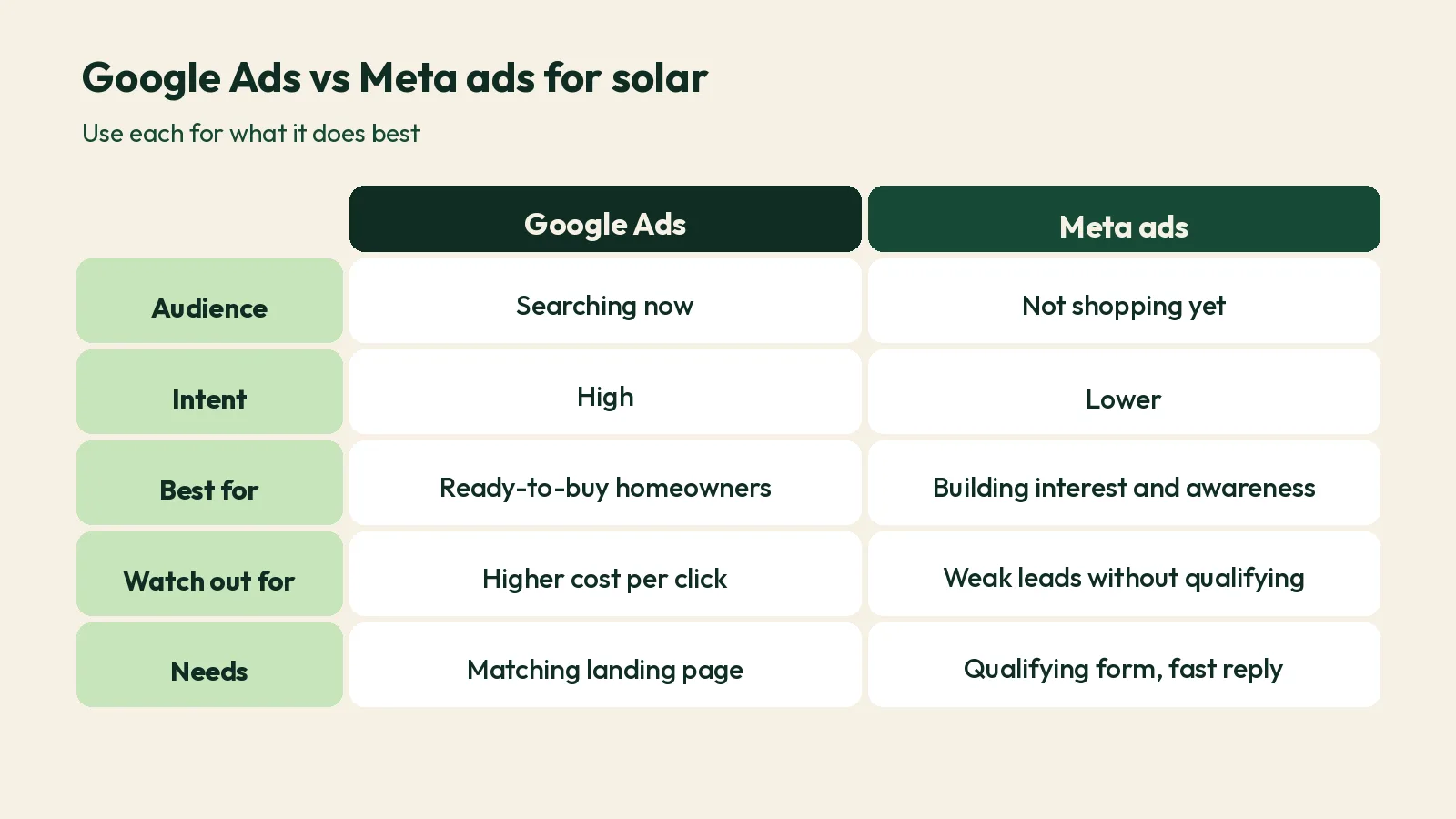
Search ads reach homeowners typing "solar panels [city]" right now. Intent is high, so leads are warmer, and clicks are often more expensive. Send each ad group to a matching page, not your homepage. Add negative keywords for jobs, DIY and out-of-area searches. See our Google Ads for contractors page.
Meta ads: create interest before they search
Facebook and Instagram reach people who haven't started shopping. You can aim at homeowners in your service area with a clear offer and real photos. Because intent is lower, qualifying questions and quick follow-up matter more. We covered this in Meta ads for booked jobs and on our Facebook ads for contractors page.
Whatever you run, the ad is only half the job. Check your landing page, your form and your response time before you scale spend.
Solar lead generation: quality over volume
Cheap leads that never answer the phone cost more than pricey leads that book. Quality comes from three choices.
- Who you target:** homeowners in your service area, not renters or out-of-state clicks.
- What the offer promises:** a clear, honest next step, like a free consultation or a no-pressure quote.
- What the form asks:** enough to qualify, not enough to scare people off.
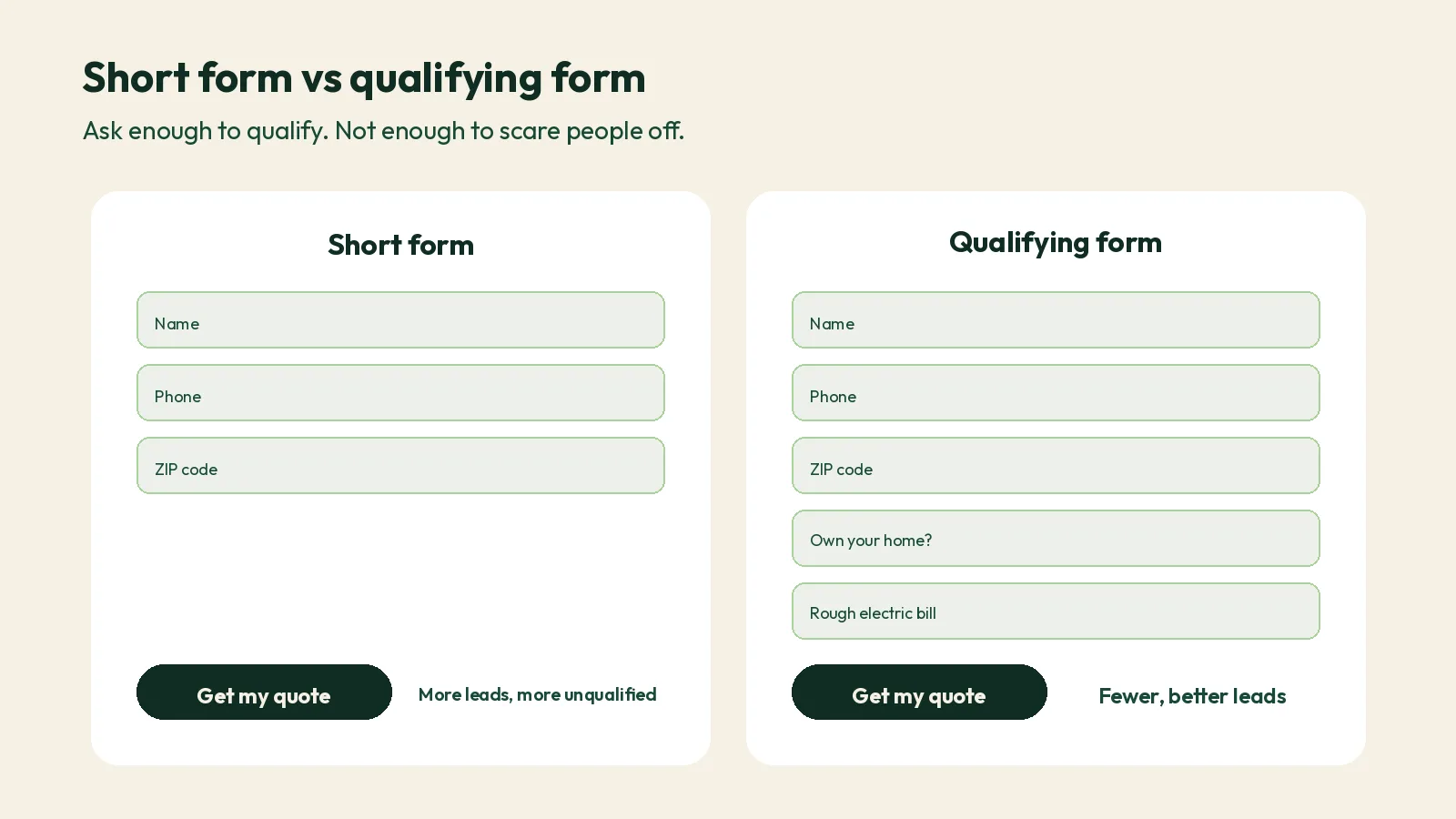
Good qualifying questions are simple: Do you own the home? What's your ZIP code? Roughly what's your electric bill? Skip anything that feels like an interrogation. For deeper tactics see solar lead generation and our contractor sales funnel guide.
Follow-up: where solar jobs are won
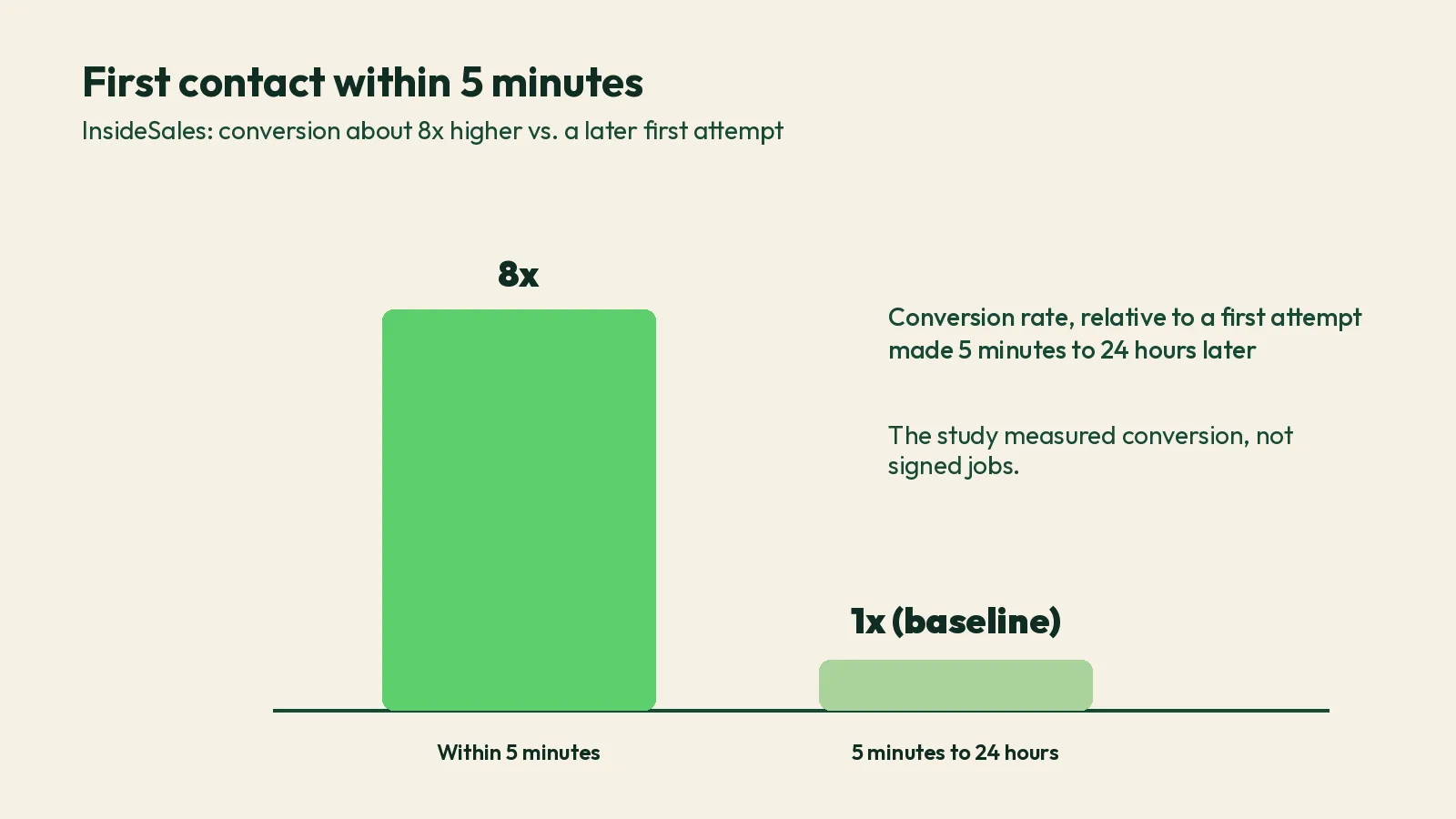
This is the step most installers neglect. A lead who fills out a form at 8 pm has probably filled out two others. One InsideSales study found that conversion was about eight times higher when the first attempt came within five minutes, yet very few leads got contacted that fast. The study measured conversion, not signed jobs, but the direction is clear. Our post on speed to lead for contractors goes through what the research does and doesn't prove.
A simple follow-up routine
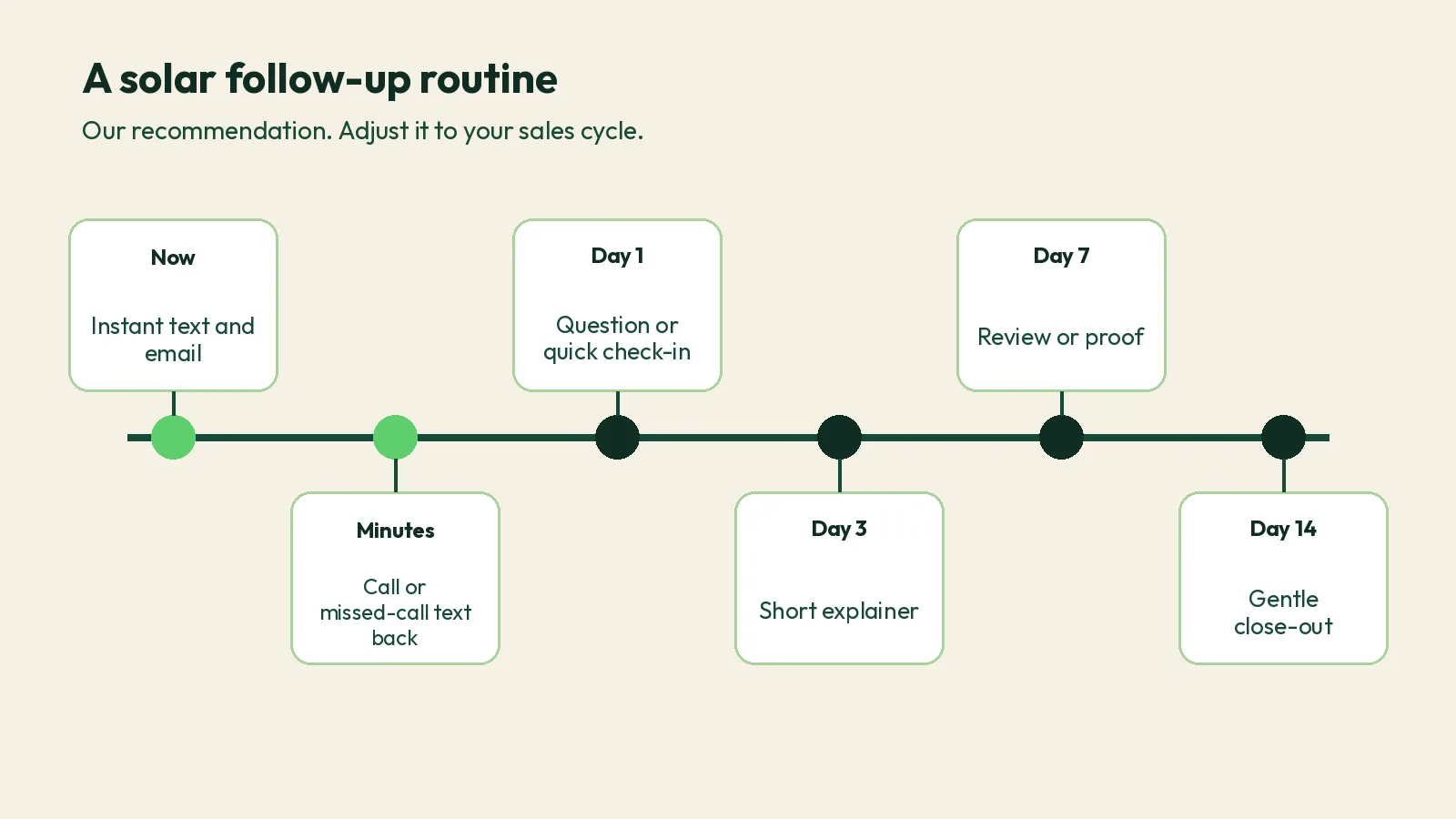
- Instant text and email** confirming you got the request and what happens next.
- A call within minutes** during business hours. Use a missed-call text back after hours, like this missed call text back script.
- Follow-up on day 1, 3, 7 and 14** with a different message each time: a question, a short explainer, a review, a gentle close-out.
- Alerts to a real person** so nothing sits in one inbox.
That cadence is our recommendation, not a statistic. Adjust it to your sales cycle. The point is to keep going until the lead books or says no. Our CRM follow-up service automates it.
Measuring digital marketing for solar companies
Marketing you can't measure is a guess. Track a short list, from the top of the funnel down to the contract.
- Leads and cost per lead:** your starting point, but not the goal.
- Time to first response:** the one number you control completely.
- Booked consultations and cost per booked consultation:** the best early signal.
- Signed contracts and cost per signed job:** what the business actually lives on.
- Source:** which channel, campaign or page each lead came from.
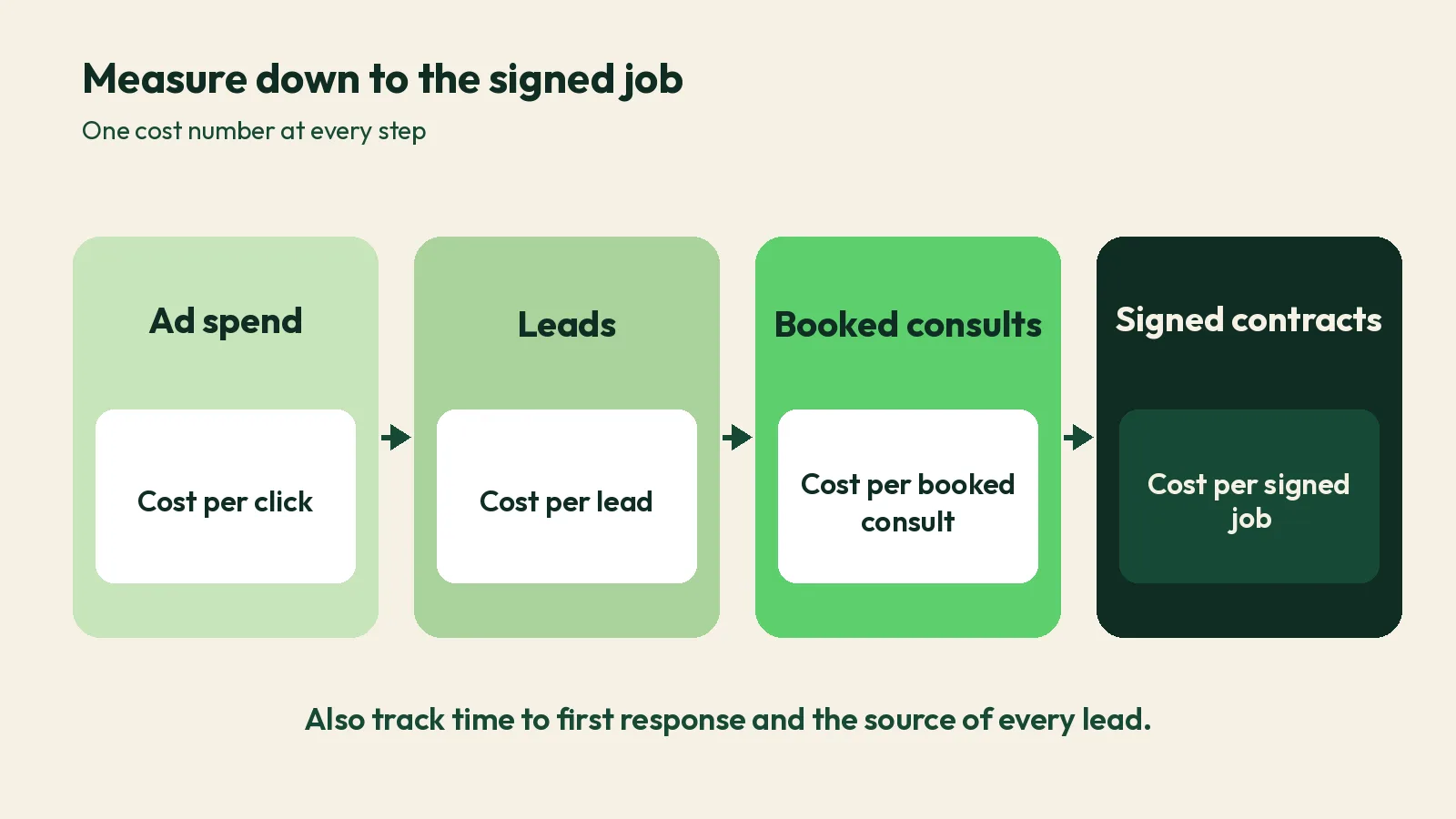
Set up call tracking, form tracking and a CRM that records the source on every lead, then review it monthly. The "Improve" step is simply fixing whichever number is weakest. Read more in our home services marketing overview, and see our FAQ for common questions.
A 90-day plan
If you're starting from scratch, do this in order.
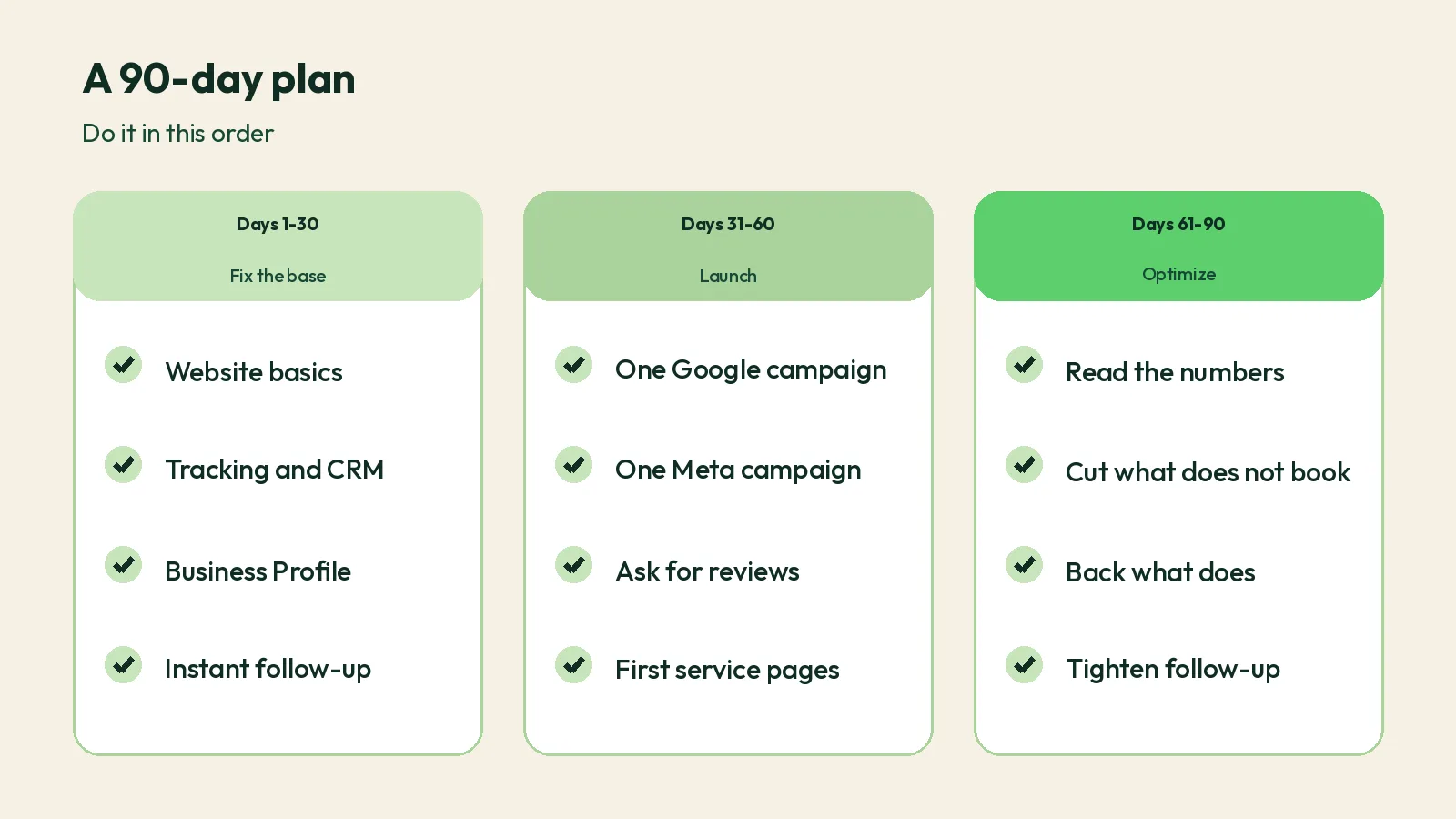
- Days 1-30:** fix the website basics, set up tracking and the CRM, tidy your Google Business Profile, build instant follow-up.
- Days 31-60:** launch one Google Ads campaign and one Meta campaign with a tight budget, ask for reviews and publish your first service pages.
- Days 61-90:** read the numbers, cut what doesn't book, put more into what does and tighten follow-up.
Want this built for your solar company?
Wondering where leads are slipping between click and consultation? A free growth call will show you.
Our onboarding is limited each month, so we can only start work with a few new companies at a time. Spots fill up. Book your growth call now →
Digital marketing for solar companies FAQ
What is the best digital marketing channel for solar companies?
There is no single best channel. Google Ads and local search catch homeowners who are already looking. Meta ads create interest in people who weren't searching yet. Both only pay off if you answer leads fast and follow up until they book or say no.
How much should a solar company spend on digital marketing?
Work backward from the number of installs you want and your close rate, then set a budget that can produce enough booked consultations. Start smaller, track cost per booked consultation, and scale only what books.
Do solar companies need SEO if they run ads?
Yes. Ads stop when the budget stops. A strong Google Business Profile, service pages and reviews keep sending local homeowners to you at no extra cost per click, and they make your ads convert better too.
How fast should a solar company respond to a new lead?
Aim for under five minutes. One InsideSales study found conversion was about eight times higher when the first attempt came within five minutes. That study measured conversion, not installs, so treat it as a strong signal, not a promise.
What should a solar company track?
Track leads, cost per lead, time to first response, booked consultations, cost per booked consultation, signed contracts and cost per signed job. Clicks and impressions are fine for diagnosis but they don't pay your crew.
Limited onboarding slots: book your call
We take on a limited number of new solar and home service companies each month so each one gets real attention. On the call we look at your website, your ads and your lead follow-up, and show you the first fixes. No generic pitch.
If you want a place in this month's onboarding, book now. Book your growth call now →
Prefer to read more first? See our solar marketing page, the growth system or our book a growth call page.
Sources
- Google Search Central, "SEO Starter Guide": https://developers.google.com/search/docs/fundamentals/seo-starter-guide
- Google Search Central, "Creating helpful, reliable, people-first content": https://developers.google.com/search/docs/fundamentals/creating-helpful-content
- Google Search Central, "Understanding Core Web Vitals and Google search results": https://developers.google.com/search/docs/appearance/core-web-vitals
- Google Business Profile Help, "Guidelines for representing your business on Google": https://support.google.com/business/answer/3038177
- BrightLocal, Local Consumer Review Survey 2026: https://www.brightlocal.com/Research/Local-Consumer-Review-Survey/
- InsideSales, Lead Response Study: https://www.insidesales.com/response-time-matters/
- U.S. Department of Energy, Solar Energy Technologies Office: https://www.energy.gov/eere/solar
For roofing, solar, HVAC, plumbing & remodeling owners
Stop chasing leads. Start booking jobs.
One short email a week with a practical play to get more calls, more booked jobs, and less wasted ad spend. Built for contractors in the US and Canada.
We respect your inbox. No spam, ever.