Speed to Lead: How Fast Contractors Should Respond to a New Lead
How fast should a contractor answer a new lead? Aim for 5 minutes. Here is what the research really shows, what it doesn't, and a simple system to get there.
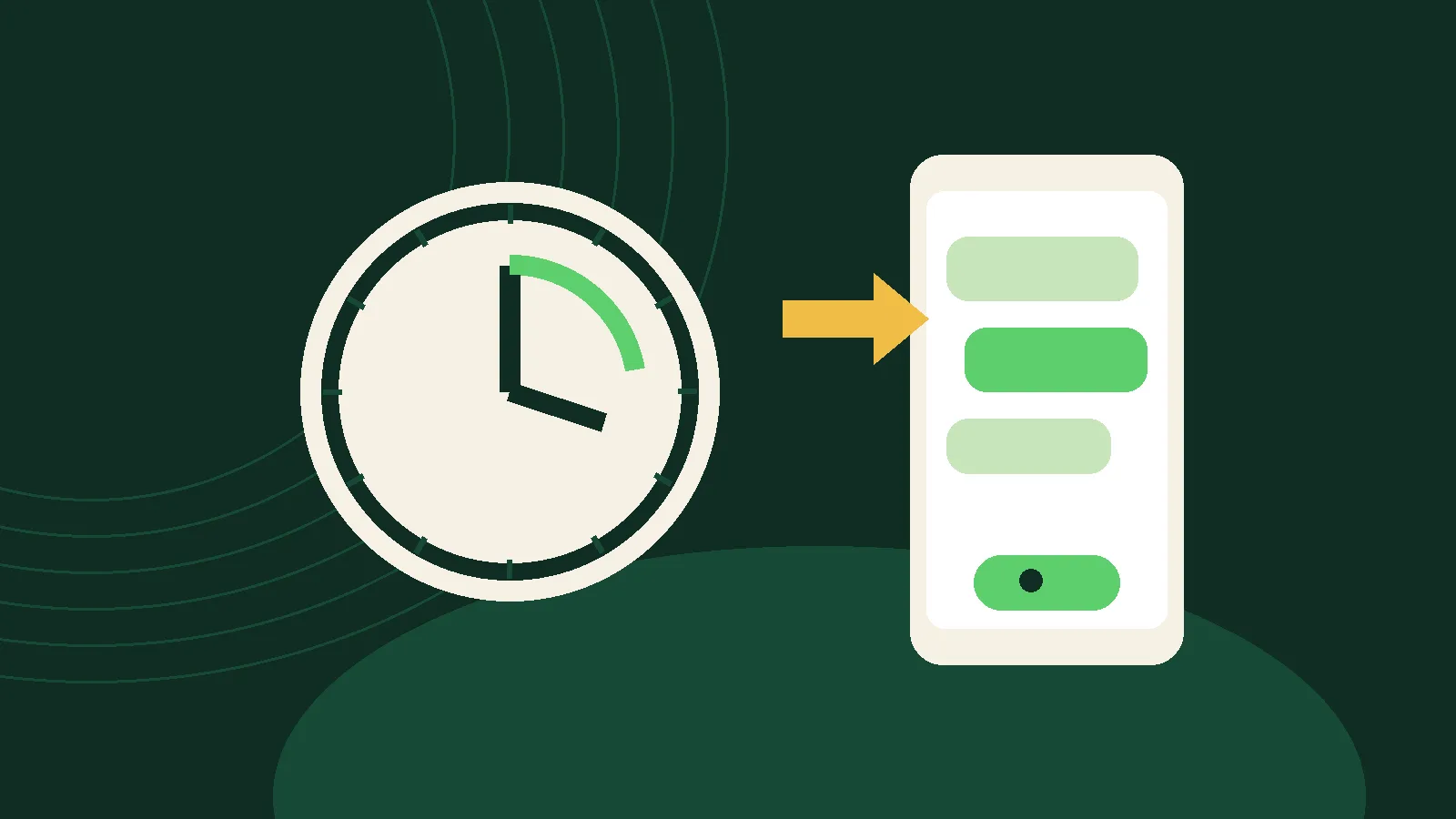
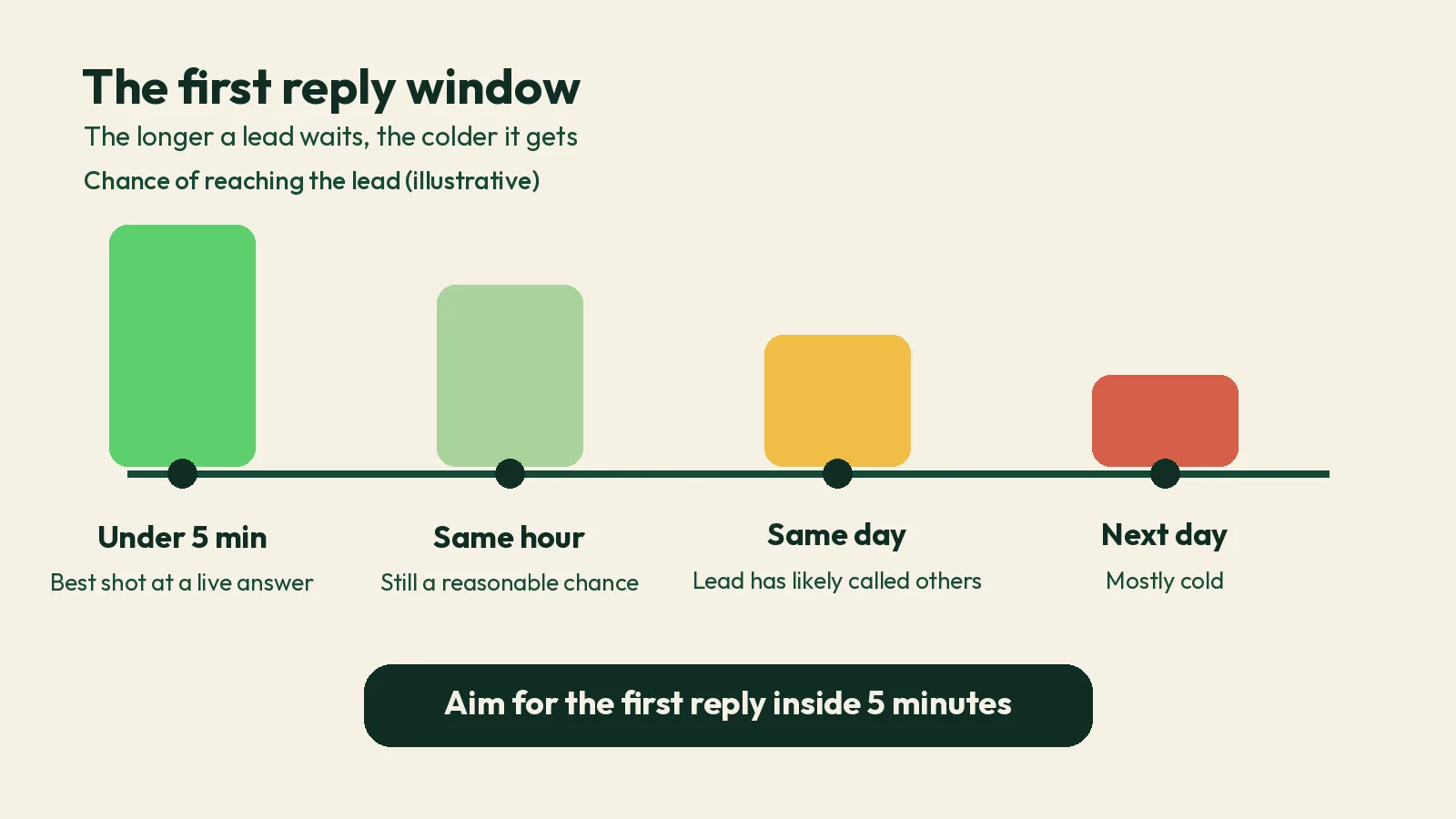
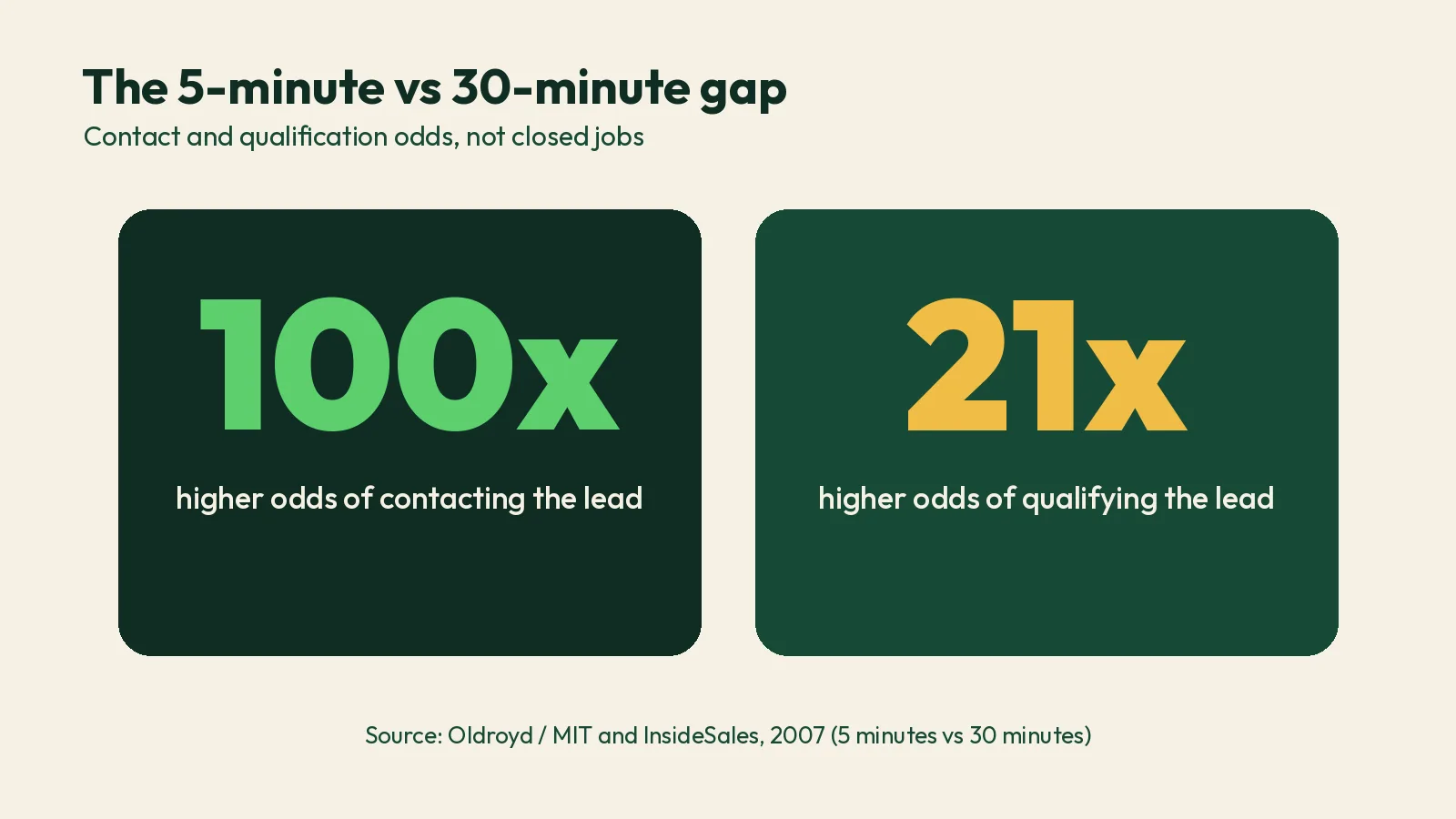
The short answer: Speed to lead for contractors means answering a new lead within 5 minutes. A 2007 MIT/InsideSales study found contact odds were 100 times higher at 5 minutes than at 30, and qualification odds 21 times higher (summary). It measured contact and qualification, not closed jobs. But a slow reply still hands the lead to someone else.
In this guide:
By Bernard Picardal Jr, founder of Able To Do. He builds lead generation and follow-up systems for home service and solar companies in the US and Canada.
A homeowner with a leaking roof or a dead AC does not fill out one form and wait. They fill out three. The first company that picks up usually gets the conversation.
That is what this post is about. We will cover what the research really shows, where the studies get overstated, and a simple setup that gets you to a fast first reply without hiring a call center.
What speed to lead for contractors means
Speed to lead is the time between a lead reaching out and your first real attempt to reach them. Lead source doesn't matter: web form, Facebook lead ad, Google Ads call, a quote request on your site, or a missed call.
For a trades business, it is not a sales buzzword. Home service leads are often urgent and they shop around. A homeowner asking for a roof estimate is probably asking two or three other companies at the same time.
Two things to separate:
- First response:** any reply that shows a human or a system got the request. An auto text counts as a start.
- First live contact:** a real conversation. This is what actually books the estimate.
You want both to be fast. Automation covers the first. Your team covers the second.
What the research says about speed to lead for contractors (and what it doesn't)
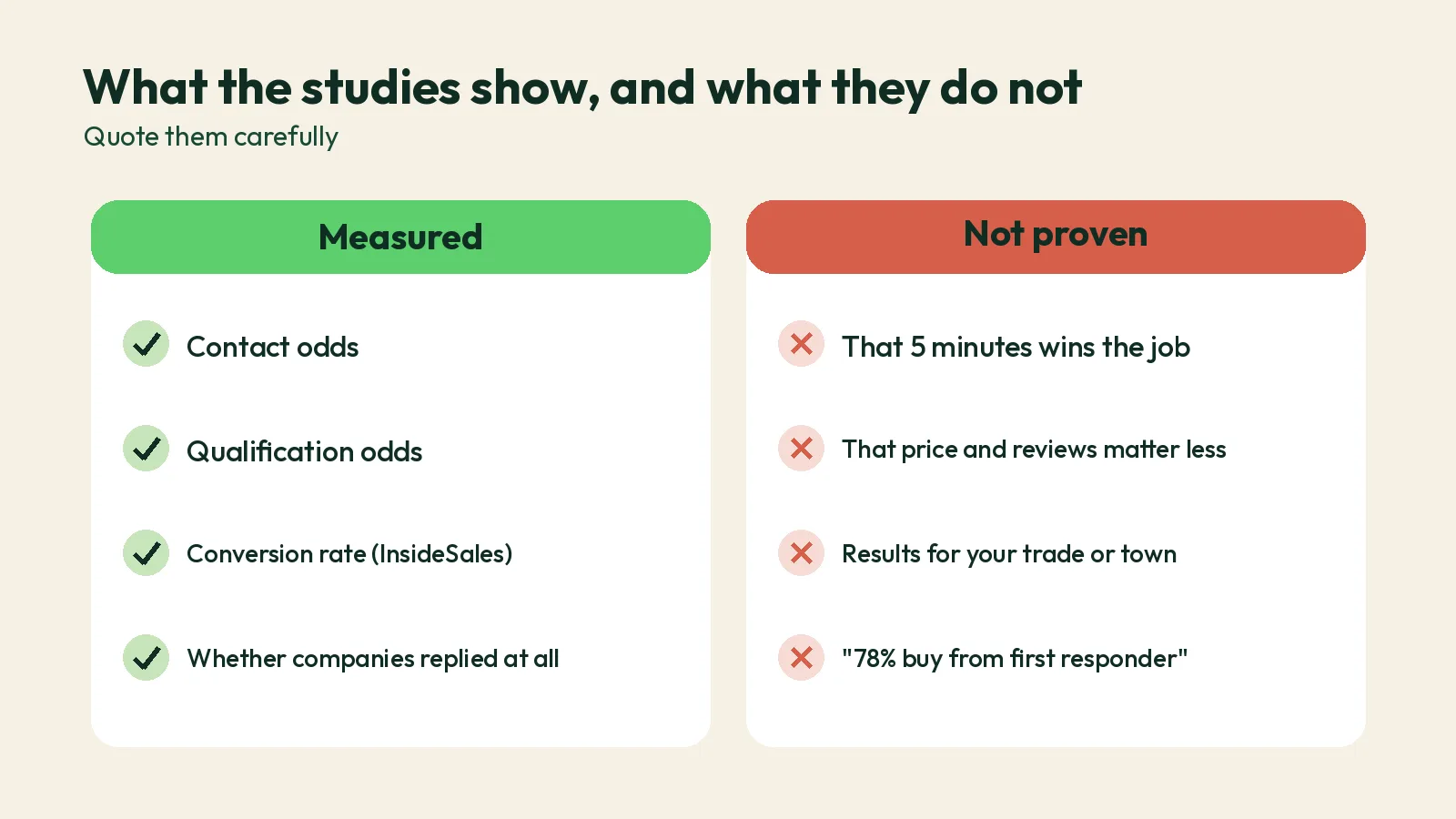
Several studies point the same way. Slow is bad. But each one measured something different, so be careful how you quote them.
MIT and InsideSales, 2007
Researchers (the study is usually credited to James Oldroyd) looked at how quickly companies called web leads. Leads called within 5 minutes were 100 times more likely to be contacted than leads called at 30 minutes, and 21 times more likely to be qualified. This summary lays out what was measured.
Note what it did not measure: closed deals. It does not tell you a 5-minute reply makes you 21 times more likely to win the job.
Harvard Business Review, 2011
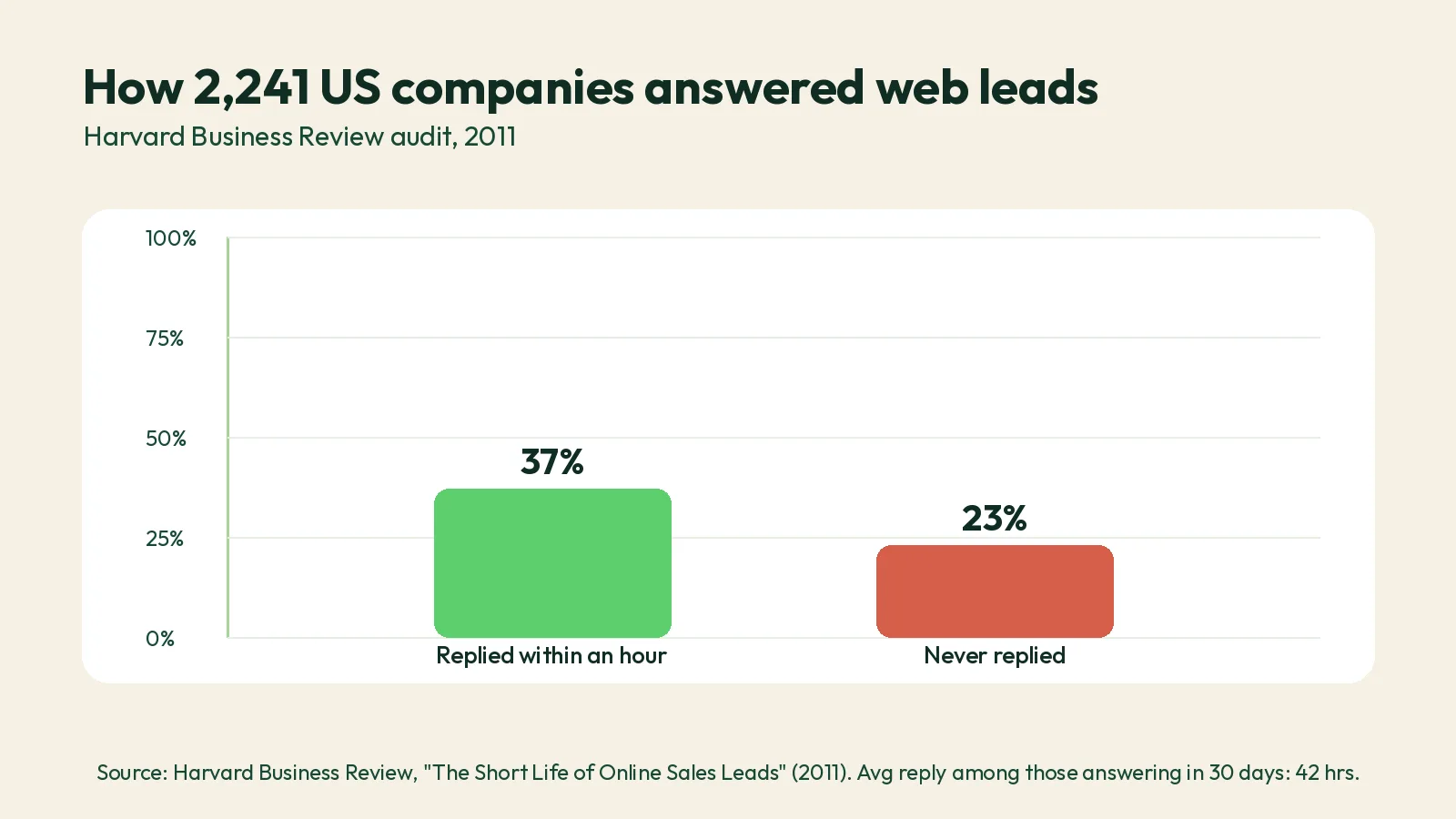
HBR audited 2,241 US companies. About 37% replied to a web inquiry within an hour. About 23% never replied at all. Among companies that replied within 30 days, the average response took 42 hours. Read the HBR article.
InsideSales, 2021
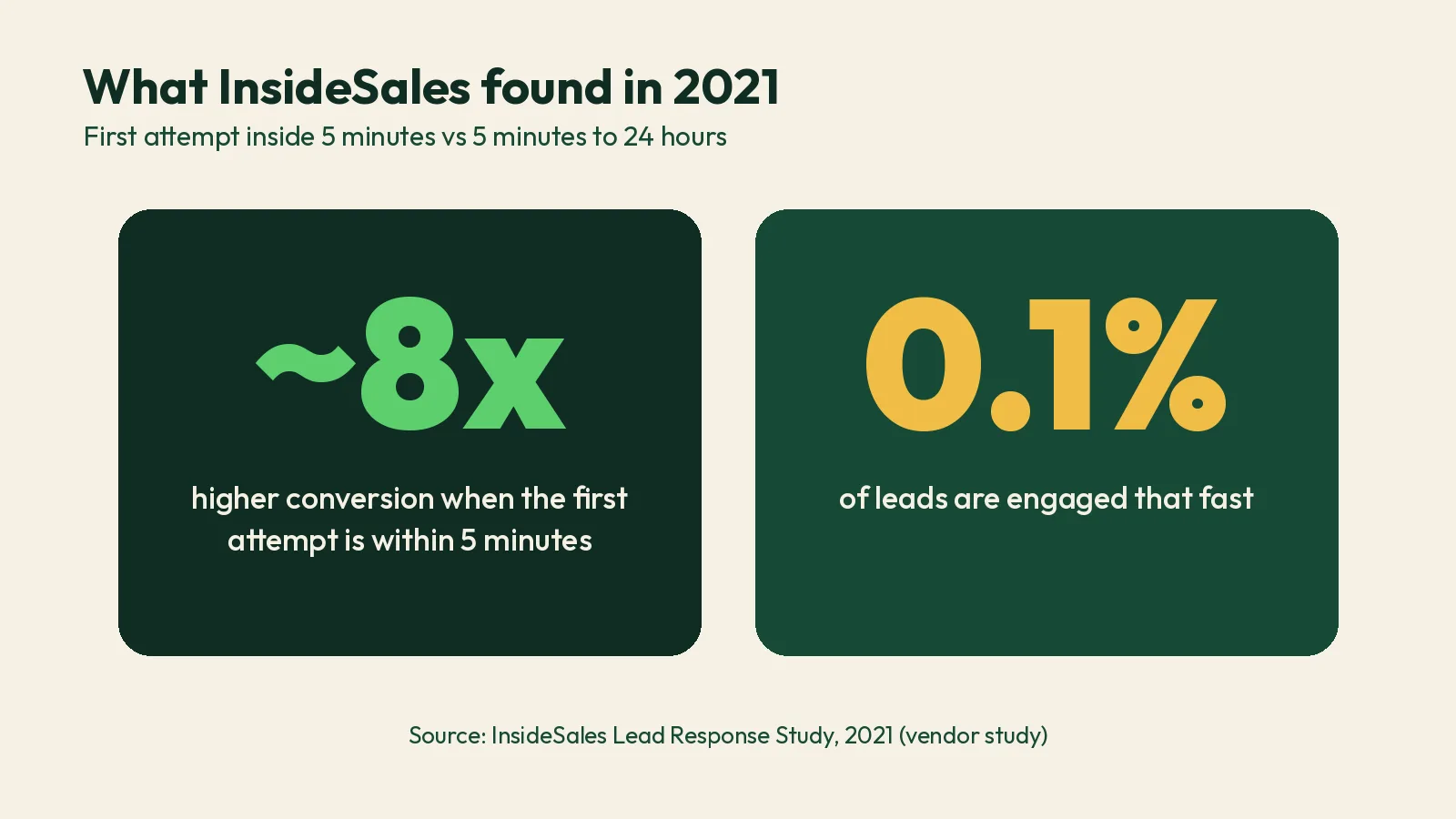
InsideSales reported that conversion was about 8 times higher when the first attempt came within 5 minutes, compared with attempts between 5 minutes and 24 hours. It also found only 0.1% of leads were engaged that fast. See the InsideSales study. This is a vendor study, so read it as a strong signal, not a guarantee.
Valve+Meter, home services
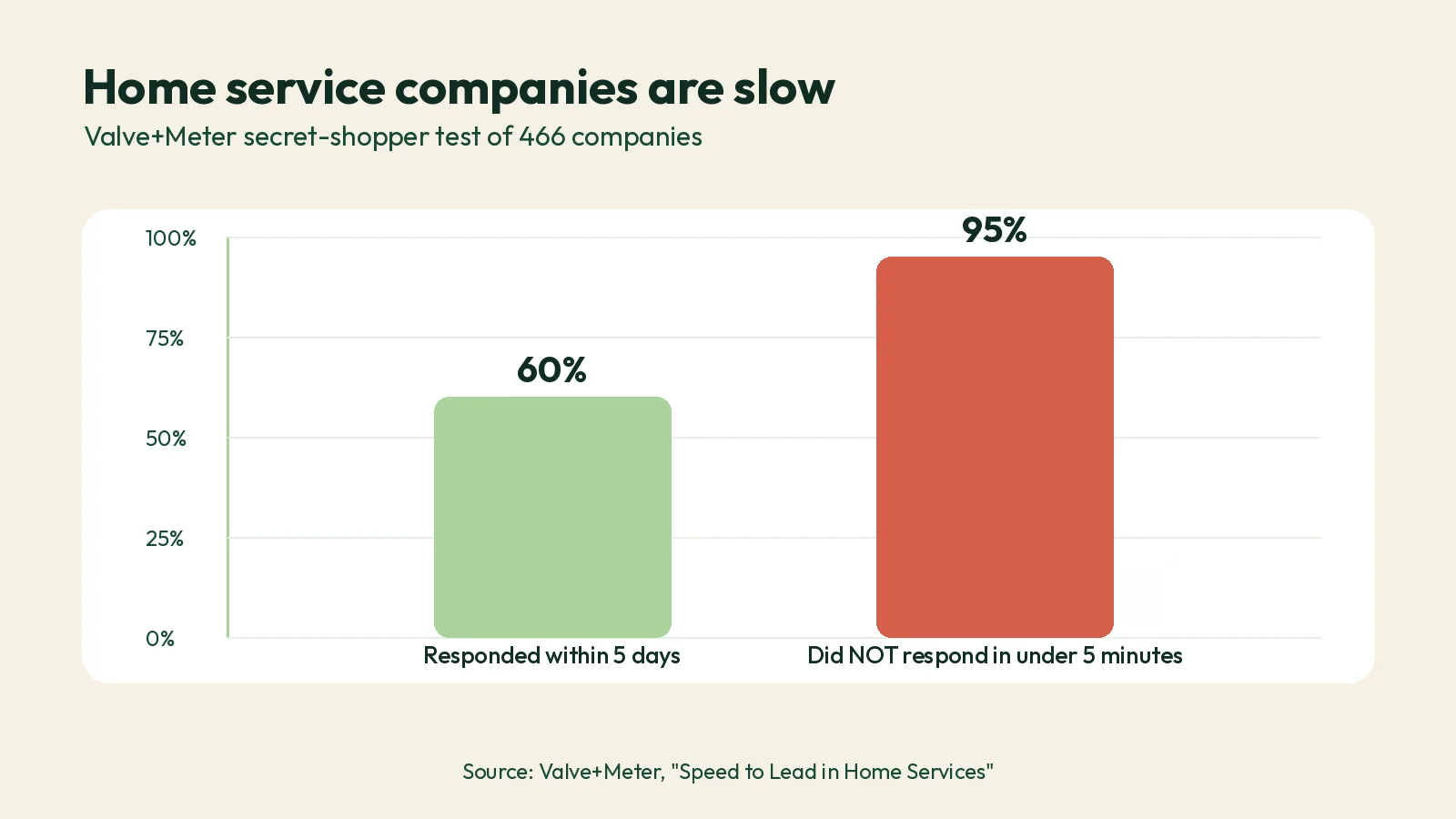
Valve+Meter ran a secret-shopper test on 466 home service companies. Only 60% responded within 5 days. The same report notes 95% did not respond in under 5 minutes. Read the report.
The good news in that: most of your competitors are slow. A fast, polite reply is an edge.
A claim to skip
You will see "78% of customers buy from the first company to respond" all over the internet. We could not trace it to the original studies, so we don't use it. If a vendor leans on that number, ask for the source.
We have limited onboarding slots each month, so book early if you want to start this quarter.

Where contractors lose leads
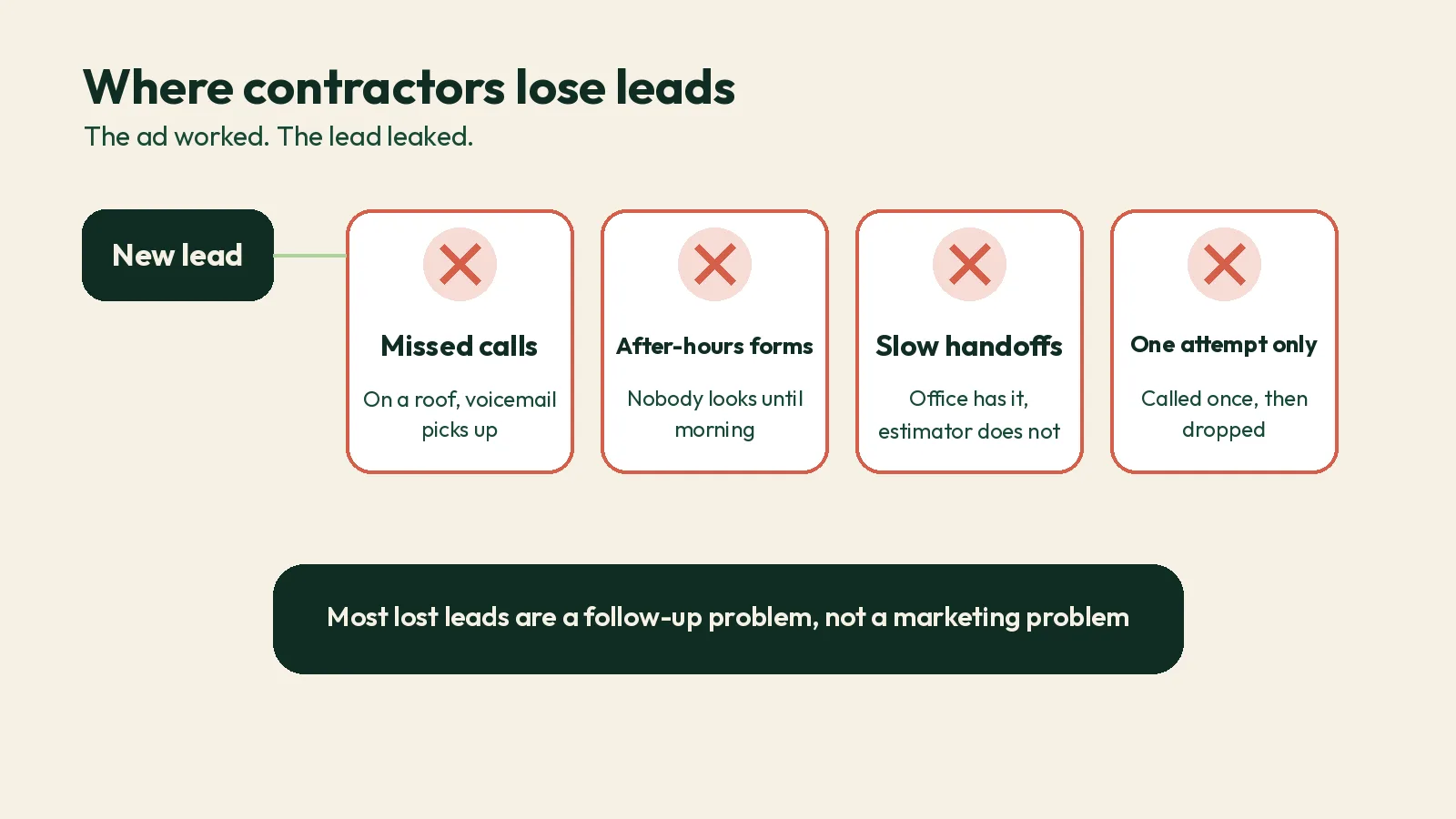
Most lost leads are not a marketing problem. The ad worked. The lead showed up. Then it leaked. The usual leaks:
- Missed calls.** You are on a roof or under a sink. The call goes to voicemail and the homeowner calls the next company.
- After-hours forms.** The form comes in at 9 pm and nobody looks until 10 am. By then the lead has talked to someone else.
- Slow handoffs.** The office gets the lead, but the estimator or crew lead is the one who can book it. The message sits.
- One attempt only.** You call once, get no answer and move on.
If you are paying for leads and still not booking, this is the first place to look. We cover the full diagnostic in Leads but not booking jobs.
It also matters whichever channel you use. Leads from Google Ads and Facebook ads both go cold fast if nobody responds.
A simple speed to lead system for contractors
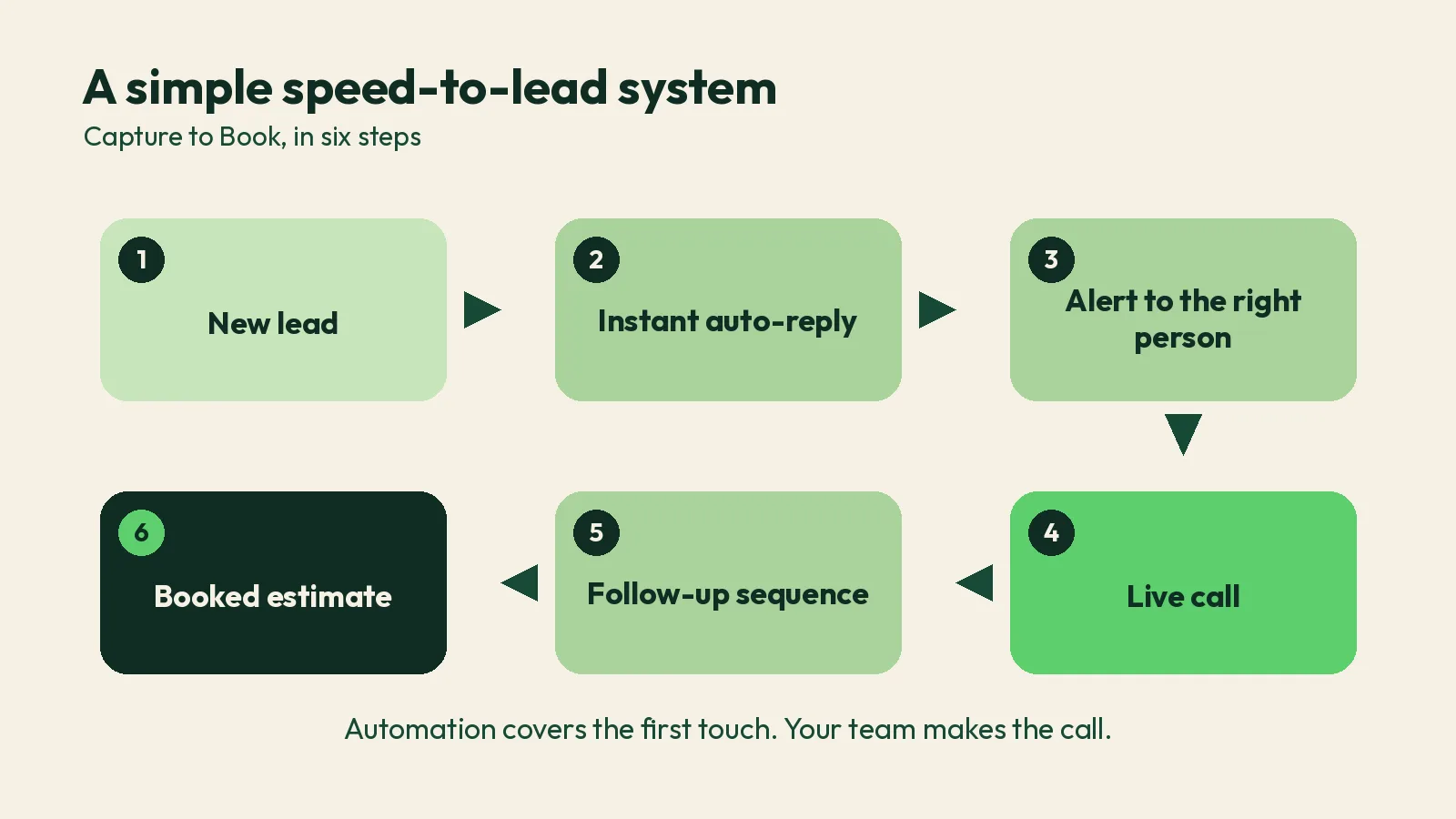
This is the Capture-to-Book step of our growth system. You don't need all of it on day one. Start at the top and work down.
1. Instant auto-reply by text and email
The moment a form is submitted, send a text and an email. Keep it human and short: who you are, that you got the request, and when they will hear from a person. Example: "Hi Sam, this is Riverside Roofing. We got your request and will call you shortly. If you need us sooner, call this number."
2. Missed-call text back
When a call goes unanswered, send an automatic text within seconds asking what they need. It turns a dead voicemail into a conversation. We wrote a ready-to-use version in our missed-call text back script for roofers.
3. Routing and alerts to whoever can book
Don't send every lead to one inbox. Send an alert to the person who can actually book the visit, with a backup if they don't pick it up in a few minutes. For a small crew, that can be your phone. For a bigger shop, it is a round-robin.
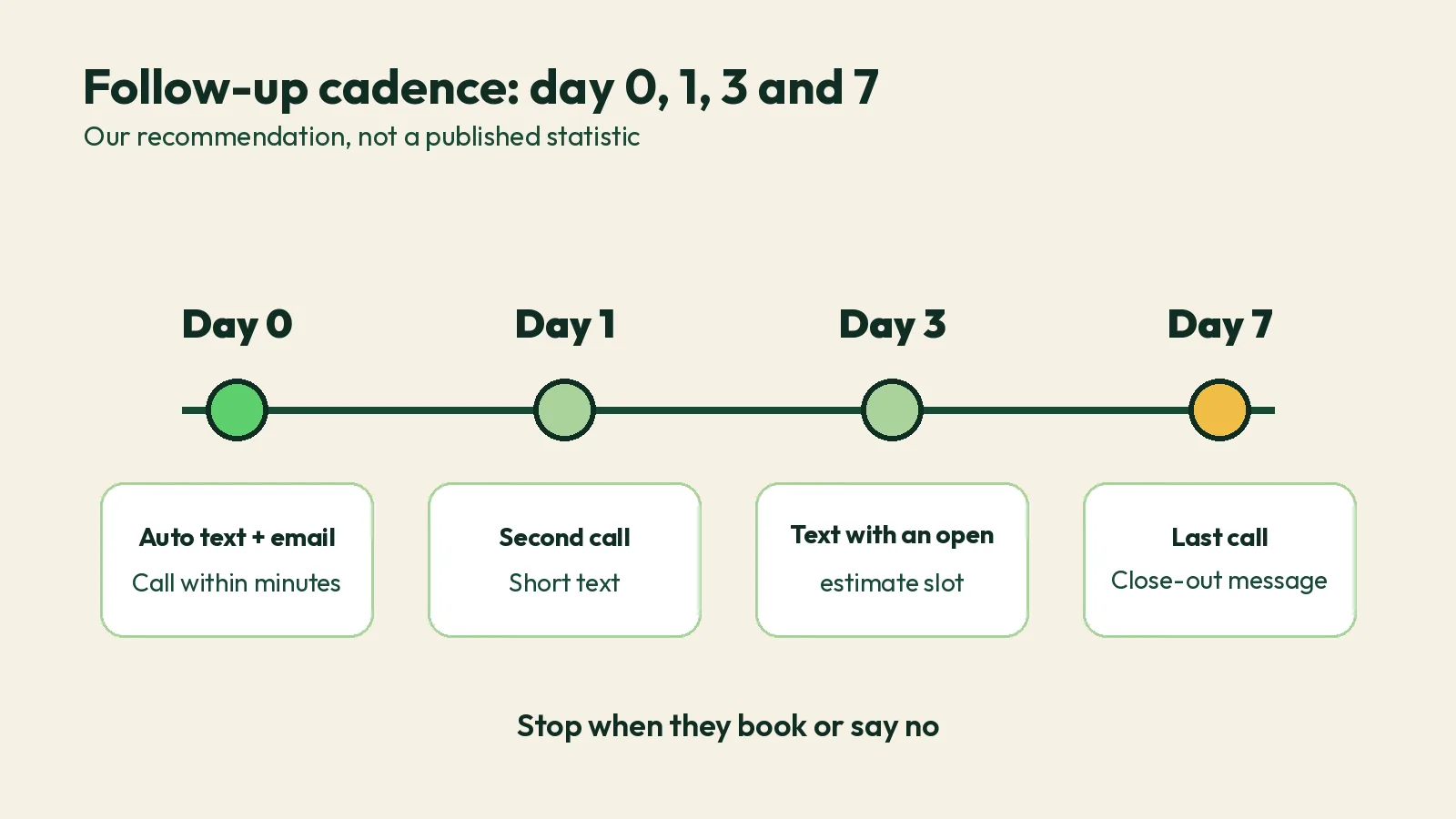
4. Follow-up cadence: day 0, 1, 3 and 7
One attempt is not follow-up. Here is a practical cadence. It is a recommendation based on how we set up sequences, not a published statistic:
- Day 0:** auto text and email, then a call within minutes.
- Day 1:** second call and a short text.
- Day 3:** text with a useful detail, like your next open estimate slot.
- Day 7:** last call and a polite close-out message.
Stop when they book or say no. If they go quiet, mark them for a later check-in. Our CRM follow-up setup automates this.
5. Track response time and booked rate in your CRM
If nobody measures it, the system drifts. Log the time each lead arrived, the time of the first reply, and the outcome. The contractor sales funnel guide shows how to read those numbers.
How to measure contractor lead response time
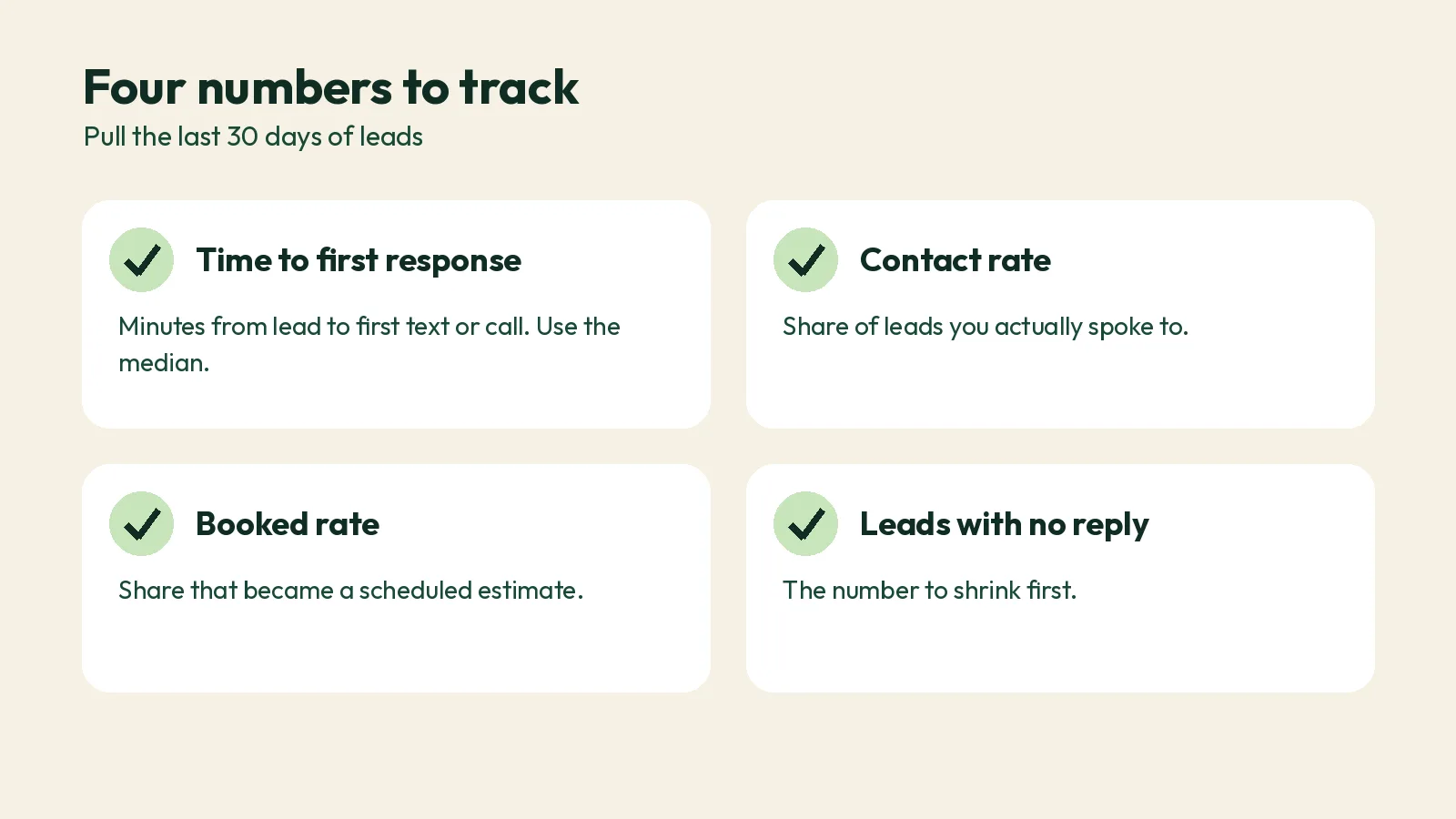
Pull your last 30 days of leads and track four numbers:
- Time to first response:** minutes from lead to first text or call. Track the median, not the best case.
- Contact rate:** the share of leads you actually spoke to.
- Booked rate:** the share that became a scheduled estimate or appointment.
- Leads with no reply at all:** the number you will most want to shrink.
Compare booked rate for leads answered in under 10 minutes with the rest. That is your own data, and it is more convincing than any study. A few weeks of tracking will show how much speed is worth to your business.
Solar sales cycles run longer, but first touch still matters. See digital marketing for solar companies and our solar lead generation page. Roofers and HVAC shops can start with roofing marketing and HVAC marketing.
Choosing where to spend? Read content marketing vs paid ads for contractors. Fast follow-up makes any channel pay off more.
Speed to lead for contractors FAQ
How fast should a contractor respond to a new lead?
Aim for 5 minutes or less during business hours. The MIT/InsideSales study found contact odds were 100 times higher at 5 minutes than at 30. If you can't hit 5 minutes, an instant automatic text is the next best thing.
Does responding faster actually win more jobs?
It raises the odds you reach the lead and qualify them. The studies measured contact and qualification, not closed jobs. Speed gets you into the conversation. Your price, reviews and estimate decide the rest. If reviews are your weak spot, see how to get recommended by ChatGPT and local search.
What if leads come in after hours?
Send an automatic text and email right away, use missed-call text back for calls, and make the first live call at opening the next morning. Tell the lead exactly when to expect it.
How many times should I follow up with a lead?
A practical cadence is day 0, 1, 3 and 7, then a polite close-out. That is our recommendation, not a statistic. Adjust it to your sales cycle.
Do I need a CRM for this?
Not on day one. A shared inbox and text alerts can work for a small team. A CRM is how you automate follow-up, stop leads falling through gaps and measure booked rate. Automatic replies and alerts also cover the first touch without extra office staff.
When to get help
If you are spending on ads or SEO and leads still slip away, the fix is usually in the follow-up, not in more traffic. We can look at your lead flow and show you where jobs are slipping.
Onboarding slots are limited each month. Book now to get a spot. Have questions first? Check the FAQ or the book-a-call page.
Sources
- Toolbench, "What the five-minute rule measured" (summary of the Oldroyd/MIT 2007 study and HBR 2011): https://toolbench.com/blueprint/what-the-five-minute-rule-measured
- Harvard Business Review, "The Short Life of Online Sales Leads" (2011): https://hbr.org/2011/03/the-short-life-of-online-sales-leads
- InsideSales, Lead Response Study 2021: https://www.insidesales.com/response-time-matters/
- Valve+Meter, "Speed to Lead in Home Services": https://valveandmeter.com/wp-content/uploads/2024/03/VM_Speed2Lead.pdf
For roofing, solar, HVAC, plumbing & remodeling owners
Stop chasing leads. Start booking jobs.
One short email a week with a practical play to get more calls, more booked jobs, and less wasted ad spend. Built for contractors in the US and Canada.
We respect your inbox. No spam, ever.